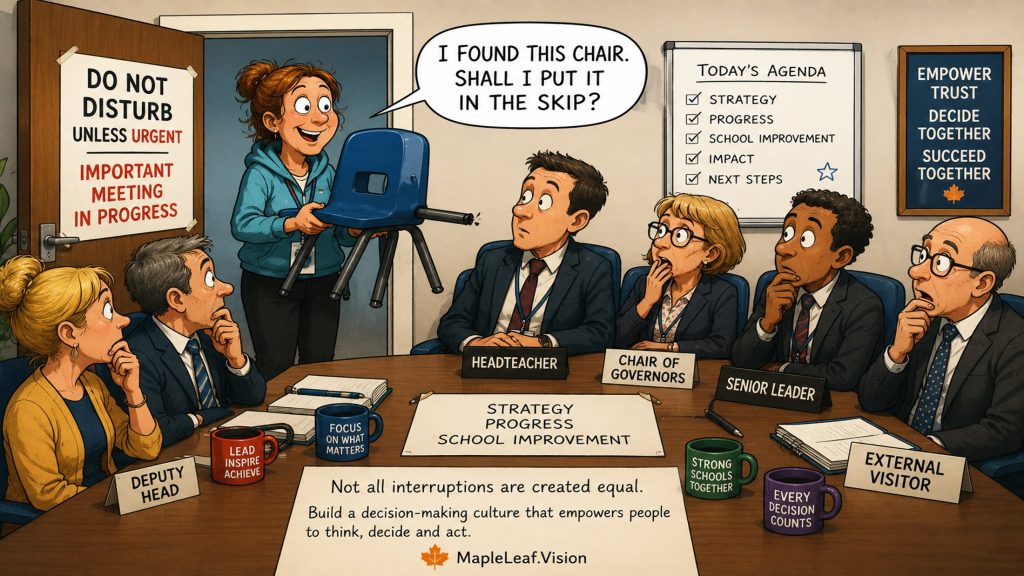
School leadership can feel relentless.
Between staffing pressures, behaviour concerns, budgets, parent communication, safeguarding responsibilities and accountability demands, many leaders spend their days firefighting rather than leading strategically.
Yet some leadership problems do not require a complete restructure, an external consultant or months of planning.
Sometimes the most effective leadership interventions are small, deliberate actions taken quickly and consistently.
Here are five common leadership problems seen regularly in schools — and practical ways to begin improving them in under 30 minutes.
1. Staff Morale Has Quietly Dropped
One of the biggest mistakes leaders make is waiting until morale becomes a crisis before addressing it.
In many schools, declining morale appears gradually:
- conversations become transactional
- enthusiasm reduces
- staff stop contributing ideas
- cynicism increases
- absence levels rise
- initiative disappears
By the time this becomes visible externally, trust has often already weakened.
A 30-Minute Leadership Fix
Spend 30 minutes intentionally reconnecting with your team.
This does not mean delivering a motivational speech.
It means:
- visiting classrooms with genuine curiosity
- thanking specific staff members for specific contributions
- asking what is currently creating pressure
- listening without immediately defending systems
- identifying one quick win you can remove or simplify
The key difference is intentional visibility.
Strong leaders do not only appear when something has gone wrong.
Why This Works
People rarely expect perfection from leadership.
They do, however, need to feel:
- seen
- valued
- heard
- supported
Small moments of authentic leadership often rebuild more trust than large strategic presentations.
2. Meetings Are Taking Too Long and Achieving Too Little
Many school leaders spend huge amounts of time in meetings that create very little meaningful impact.
Poor meetings drain energy quickly because they often involve:
- too much information sharing
- unclear outcomes
- repetitive updates
- unnecessary attendees
- problems without ownership
When this becomes habitual, staff begin associating leadership meetings with frustration rather than progress.
A 30-Minute Leadership Fix
Review your next scheduled meeting agenda immediately.
Ask:
- What decisions actually need to be made?
- What information could simply be emailed?
- Which items are genuinely strategic?
- Does everyone in the room need to attend?
- What action should exist by the end?
Then simplify aggressively.
One of the strongest leadership skills is reducing noise.
Why This Works
Clarity creates momentum.
When meetings become shorter, sharper and outcome-focused:
- accountability improves
- staff engagement increases
- time pressure reduces
- decision-making becomes clearer
Strong leadership is often about protecting people’s energy and focus.
3. Staff Are Becoming Resistant to Change
Resistance to change is often misunderstood.
In schools, resistance is not always negativity.
Sometimes it is exhaustion.
Sometimes it is uncertainty.
Sometimes it is the result of too many initiatives arriving without clarity, consistency or explanation.
Leaders often unintentionally overload staff with competing priorities.
A 30-Minute Leadership Fix
Choose one current initiative and answer these three questions clearly:
- Why are we doing this?
- What problem does it solve?
- What does success actually look like?
Then communicate this simply and consistently.
Do not assume people automatically understand the strategic purpose behind change.
Why This Works
People support what they understand.
When staff can clearly see:
- the purpose
- the impact
- the intended outcome
buy-in improves significantly.
Leadership communication is often less about saying more and more about creating clarity.
4. You Are Constantly Firefighting
Many leaders unknowingly spend their entire week reacting.
Emails.
Behaviour incidents.
Staffing gaps.
Complaints.
Urgent operational issues.
Over time, reactive leadership becomes normalised.
The danger is that strategic leadership quietly disappears.
A 30-Minute Leadership Fix
Block out 30 uninterrupted minutes in your diary every week purely for strategic thinking.
No emails.
No interruptions.
No operational tasks.
Use this time to ask:
- What problems keep repeating?
- What is causing unnecessary pressure?
- What could be prevented earlier?
- What requires longer-term planning?
- What am I currently avoiding?
This small discipline creates leadership space.
Why This Works
Good leaders solve today’s problems.
Great leaders reduce tomorrow’s problems.
Strategic thinking rarely appears accidentally in education leadership.
It has to be deliberately protected.
5. Leadership Decisions Are Bottlenecked Around One Person
In struggling leadership cultures, decisions often become centralised around one individual.
This creates:
- slower progress
- reduced ownership
- weaker middle leadership
- dependency
- leadership fatigue
Schools become fragile when too much sits with too few people.
A 30-Minute Leadership Fix
Identify one area where responsibility could be shared more effectively.
Then ask:
- Who is ready for more ownership?
- What could be delegated safely?
- Where could decision-making be distributed?
- What support would that person need?
Strong leadership is not about controlling everything.
It is about building leadership capacity in others.
Why This Works
Schools become healthier when leadership is distributed.
People develop confidence when trusted with responsibility.
Teams become stronger when leadership is collaborative rather than dependent on a single individual.
Final Thoughts
School leadership will never be pressure-free.
However, many leadership problems improve not through dramatic intervention, but through small, intentional leadership habits repeated consistently.
The strongest leaders are often not the loudest.
They are the leaders who:
- create clarity
- reduce unnecessary pressure
- build trust
- protect culture
- communicate purpose
- develop people around them
Sometimes meaningful leadership improvement begins with just 30 focused minutes.