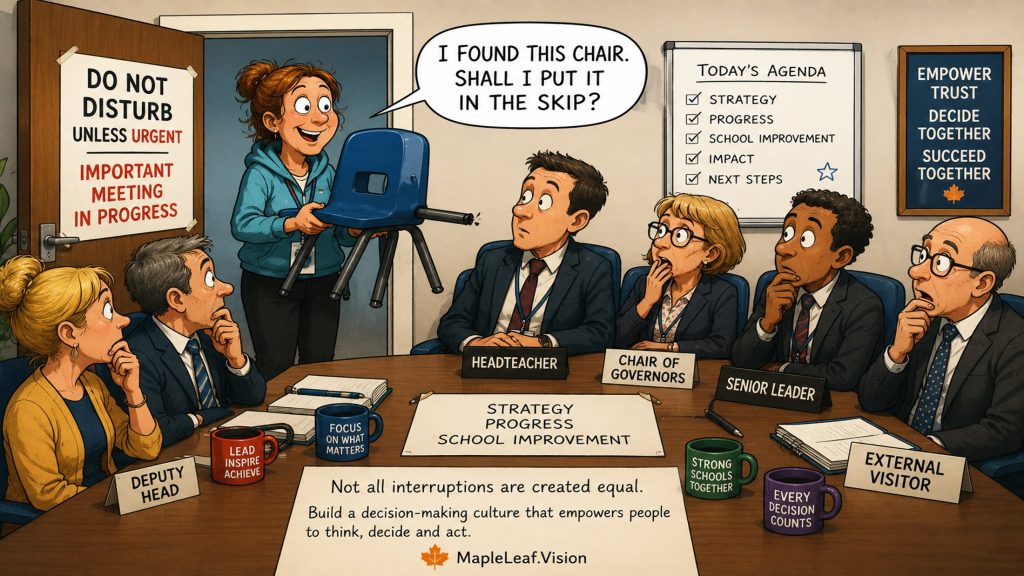
Especially when your classroom assistant has their foot stuck inside a rubbish bin in the middle of a lesson.
I worked with a lunatic.
At the time, I was a trainee primary school teacher still trying to survive the basics of classroom life.
I was learning:
- lesson planning
- behaviour management
- teacher presence
- classroom control
- how to deploy a teaching assistant effectively
There were already enough distractions mentally and physically.
What I needed more than anything was focus.
Then came the rubbish bin incident.
In the middle of a lesson, right at the point where the children were listening carefully to the next stage of teaching input, I noticed out of the corner of my eye that my teaching assistant had decided to put her foot into a small rubbish bin to stamp the paper down.
It was not ideal timing.
It was not an excellent decision.
Her foot got stuck.
For a few moments, she tried quietly pulling her foot back out while pretending nothing unusual was happening.
It did not work.
There she was, standing in the middle of the classroom with her foot trapped inside a bin.
I carried on teaching.
Teacher training had not specifically prepared me for this scenario.
Then came the noise.
Clunk. Clunk. Clunk.
Unable to free herself — and seemingly determined not to interrupt the lesson — my teaching assistant began slowly making her way towards the classroom cupboard with the bin still attached to her foot.
Clunk. Clunk. Clunk.
Some children noticed.
At that exact moment, I realised something important.
If I lost focus, I would lose the class.
So while trying not to laugh internally, I used every behaviour management strategy I had to maintain calm, attention and control.
Clunk. Clunk. Clunk.
Eventually, the teaching assistant disappeared into the cupboard area where a combination of shuffling, scraping and grunting sounds finally resulted in the bin being removed.
I would love to say this was an isolated incident.
It was not.
This was also the same teaching assistant who once walked around school with a perfect Christmas-tree-shaped hole in her skirt after sitting on the carpet cutting Christmas cards with the children.
Working with a lunatic provided endless entertainment.
But strangely enough, it also taught me some of the most valuable lessons about leadership focus I have ever learned.
Because one of the biggest challenges facing modern schools is not simply workload.
It is distraction.
Constant distraction.
Educational leaders now operate inside environments where attention is pulled in multiple directions simultaneously.
Emails.
Messages.
Safeguarding concerns.
Behaviour incidents.
Staffing shortages.
Data demands.
Parent communication.
Social media.
Policy changes.
Inspection pressure.
Budget pressures.
Crisis management.
And somewhere inside all of that, leaders are still expected to think strategically, lead people well and improve outcomes.
The problem is that distraction does not simply affect productivity.
It affects clarity.
Decision-making.
Culture.
Energy.
And ultimately leadership itself.
One of the most dangerous realities within education is that many professionals become so consumed by reacting that they gradually lose the ability to focus intentionally.
Schools Are Full of Urgency — But Not Everything Is Truly Important
One of the hardest leadership lessons in education is learning the difference between:
- urgent
- important
- distracting
- emotionally noisy
Schools naturally generate urgency.
There will always be:
- immediate problems
- operational pressures
- emotional demands
- unexpected situations
But strong leadership increasingly depends on recognising which issues genuinely deserve strategic attention.
Because leaders who constantly operate in reactive mode often end up:
- emotionally exhausted
- operationally overwhelmed
- strategically unfocused
- unable to prioritise effectively
And over time, entire school cultures can become driven by interruption rather than intention.
Educational Leadership Now Requires Focus Discipline
Many school leaders are exceptionally hardworking.
But hard work alone is no longer enough.
Modern educational leadership increasingly requires focus discipline.
The ability to:
- prioritise clearly
- filter noise
- protect strategic thinking
- maintain perspective under pressure
- avoid constant reactive leadership
This is difficult because schools are emotionally intensive environments.
People naturally care deeply.
Everything can feel important.
However, leaders who attempt to solve everything simultaneously often end up diluting impact across the organisation.
The Real Cost of Constant Distraction
Distraction in leadership is not always obvious.
Sometimes it appears as:
- endless task switching
- fragmented thinking
- inability to complete strategic work
- emotional overload
- reduced decision quality
- reactive communication
- constant firefighting
Over time, distraction can begin affecting:
- school culture
- staff morale
- consistency
- leadership credibility
- wellbeing
- long-term improvement planning
When leadership attention becomes scattered, organisations often become scattered too.
Teachers Recognise This Reality Instantly
One reason this topic resonates strongly in education is because teachers and school leaders experience it daily.
Many professionals recognise the feeling of trying to:
- respond to safeguarding concerns
- support distressed pupils
- manage behaviour
- cover absent staff
- answer emails
- prepare meetings
- complete data deadlines
- support parents
- maintain teaching quality
all within the same day.
And often while carrying emotional pressure privately.
The issue is not laziness.
The issue is cognitive overload.
Modern schools demand enormous emotional and mental bandwidth.
Focus Is Now a Leadership Skill
Historically, leadership was often associated with:
- visibility
- decisiveness
- authority
- operational control
But increasingly, one of the most important leadership skills is intentional focus.
Strong leaders often succeed not because they do everything.
But because they remain clear about:
- priorities
- values
- long-term direction
- strategic purpose
This clarity creates calmer leadership.
And calmer leadership often creates calmer organisations.
Educational Leaders Must Protect Thinking Time
One of the biggest risks in schools is that leaders become permanently operational.
Entire weeks disappear inside:
- meetings
- interruptions
- emergencies
- emails
- compliance tasks
leaving almost no space for strategic thought.
But without protected thinking time, leadership quality often deteriorates.
Because thoughtful leadership requires space for:
- reflection
- planning
- analysis
- perspective
- long-term decision-making
Schools rarely improve sustainably through permanent crisis management.
The Best Leaders Often Simplify
Some of the strongest school leaders are not necessarily those doing the most.
Often they are the people who create:
- clarity
- consistency
- prioritisation
- calmer systems
- focused improvement
They understand that organisations become stronger when people know:
- what matters most
- what the priorities are
- what can wait
- what deserves energy
This does not remove pressure.
But it reduces chaos.
And educational leadership increasingly requires the ability to reduce unnecessary complexity.
Focus Also Protects Wellbeing
One of the most overlooked realities is that constant distraction damages wellbeing.
When professionals never mentally disengage from reactive pressure, stress becomes continuous.
Many educators describe feeling:
- mentally overloaded
- emotionally fragmented
- unable to switch off
- permanently behind
- cognitively exhausted
This affects not only performance, but sustainability.
Schools need leaders who can endure.
Not simply survive short periods of intensity.
Practical Leadership Strategies for Reducing Distraction
Strong educational leaders often intentionally create structures that protect focus.
This may involve:
- clearer prioritisation
- reducing unnecessary meetings
- streamlining communication
- protecting strategic planning time
- delegating effectively
- simplifying systems
- reducing duplication
- setting realistic operational expectations
The goal is not perfection.
It is creating enough clarity for meaningful work to happen consistently.
Leadership Culture Matters
School culture often mirrors leadership behaviour.
If leadership culture becomes:
- reactive
- chaotic
- constantly interrupted
- emotionally volatile
staff often absorb the same patterns.
But where leadership creates:
- clarity
- consistency
- calm communication
- strategic focus
organisations often become healthier and more sustainable.
Leadership attention shapes organisational attention.
Final Thoughts
Distractions in education are unlikely to disappear.
Modern schools are complex, emotionally demanding organisations operating under constant pressure.
However, strong leadership increasingly depends on learning how to focus intentionally within that complexity.
Because leadership is no longer simply about doing more.
It is about deciding what matters most.
The strongest educational leaders are often not those reacting to every demand.
But those able to maintain:
- clarity
- perspective
- strategic focus
- emotional steadiness
- purposeful decision-making
amid enormous noise.
And in many schools today, that ability may be one of the most important leadership skills of all.